
Richmond, Virginia, is a place where thousands of years of human history meet the energy of a modern American community. Richmond was laid out in 1737, established as a town in 1742, became Virginia’s capital in 1779, and was incorporated as a city in 1782. Located at the fall line of the James River, Richmond developed at a natural crossroads of waterways, trade routes, government, and industry. Its history encompasses Indigenous civilizations, colonial settlement, the American Revolution, slavery and the domestic slave trade, the Civil War, African American achievement, civil rights, higher education, and the continuing transformation of neighborhoods and culture.
Use the player's timeline to seek through the narration, or use the 15-second skip buttons.
Understanding Richmond means looking beyond its familiar landmarks. Beneath its streets and along its riverbanks are traces of ancient communities. Its historic buildings reveal the ambitions and conflicts of different eras, while burial grounds, neighborhoods, and public spaces preserve stories that were often excluded from official accounts. Together, these places tell the story of a city continually shaped by geography and by the choices, labor, creativity, and resilience of its people.

Before Richmond: Archaeology and Indigenous History
Long before Richmond was established as a colonial town, Indigenous peoples lived, traveled, hunted, farmed, and traded throughout the region. Archaeological evidence places human presence in Virginia thousands of years before European colonization. Surveys in the greater Richmond area have recovered stone projectile points, stone flakes left by toolmaking, scrapers, ground-stone tools, and fragments of Native American pottery. The location, material, and context of these discoveries help archaeologists reconstruct how people used the landscape over generations.
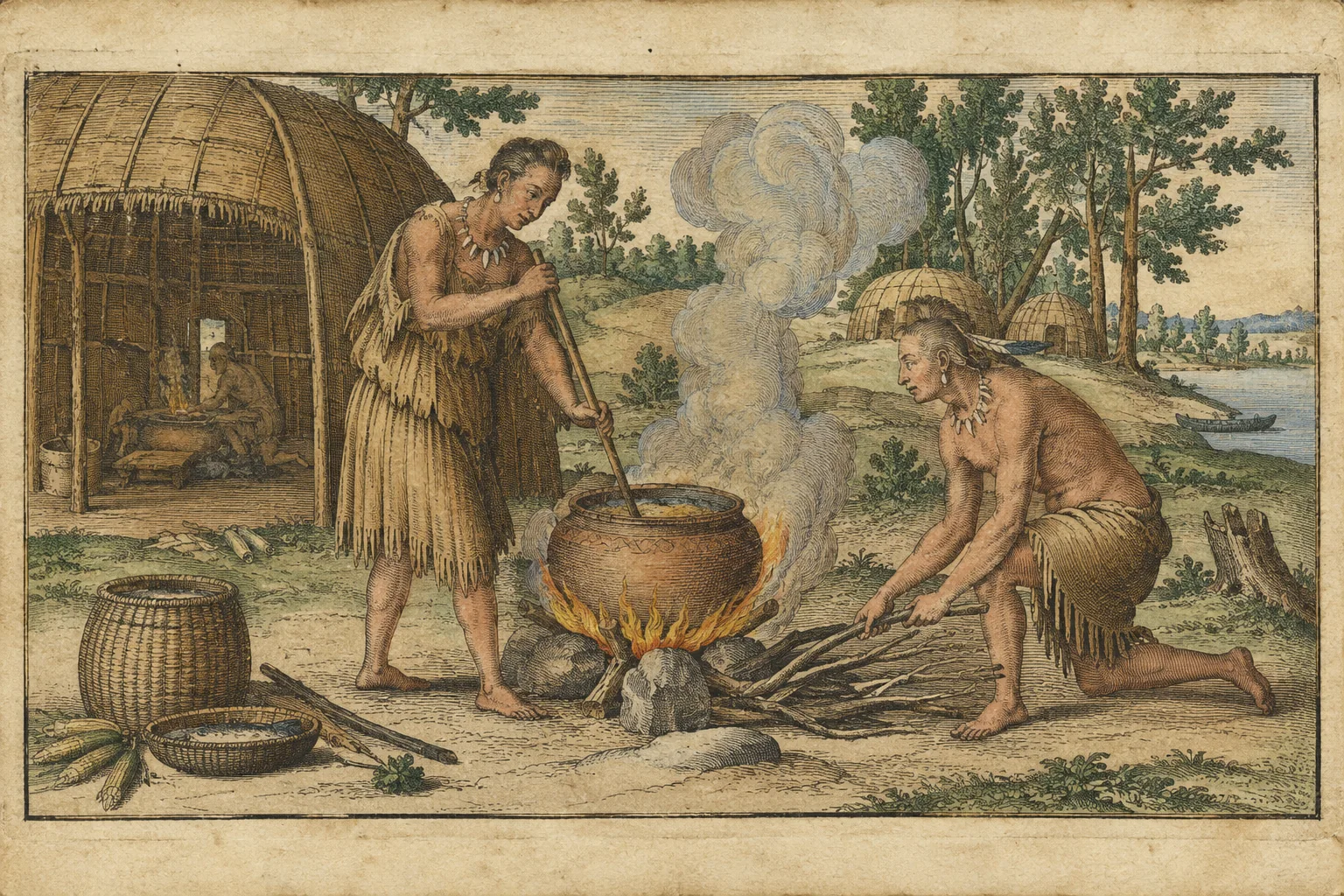
Rivers offered drinking water, fish, transportation, and access to different ecological environments. Forests and open lands provided plants, game, and raw materials. Over time, Indigenous communities developed extensive knowledge of the region and sophisticated traditions of agriculture, exchange, craftsmanship, and community life. Pottery fragments, for example, can help archaeologists study food preparation, technology, and the chronology of occupation.
An important geographical feature shaped the region's history: the fall line, where the Piedmont's higher ground transitions to the Atlantic Coastal Plain. At Richmond, rocky rapids interrupt navigation along the James River. The falls created a natural stopping point for people traveling by water and linked river routes with paths leading farther inland.
The region lay between two broad Indigenous cultural and political worlds. To the east were Algonquian-speaking communities associated with Tsenacomoco, the extensive Powhatan paramount chiefdom. To the west were Siouan-speaking peoples, including the ancestors of the Monacan Indian Nation, whose traditional territories extended across the Piedmont toward the Blue Ridge Mountains. The fall line was a transitional area between these worlds—not a rigid line separating peoples whose relationships, trade, and movement changed over time.
The Powhatan peoples developed networks of agriculture, diplomacy, trade, and political alliance throughout the Tidewater. Monacan ancestors also cultivated crops, hunted, gathered wild foods, crafted tools, and participated in regional exchange. These societies had their own histories and traditions long before English colonists began recording encounters with them.
Colonization, warfare, forced land loss, and introduced diseases profoundly affected Indigenous communities. But Indigenous history did not end with the arrival of the English. Virginia's tribal nations and descendant communities remain part of the present. The Commonwealth of Virginia's overview of Virginia Indians, the Monacan Indian Nation's history, and the National Park Service's overview of Indigenous heritage near Richmond provide important context.
English Exploration and the Founding of Richmond
English colonists began exploring the James River in 1607, the year they established Jamestown. Expeditions traveled upriver toward the falls near present-day Richmond and into lands occupied by Indigenous communities, including Monacan peoples west of the falls. These encounters involved trade and diplomacy as well as competition, conflict, and increasingly unequal struggles over territory and political authority.

English settlement around the falls expanded during the seventeenth century. Permanent settlement and agricultural development grew as the Virginia colony expanded, with tobacco becoming a major commercial crop. By the early eighteenth century, the falls location was increasingly recognized for its potential as a trading point connecting inland producers with markets reachable by the James River.
In 1737, William Mayo surveyed a street plan on the north side of the river under the direction of William Byrd II. Byrd advertised lots for sale in the Virginia Gazette that April, promoting the area's location and commercial prospects. The town took the name Richmond, likely inspired by Richmond upon Thames in England. Richmond was incorporated as a town in 1742.
The fall line remained central to the settlement's growth. Boats could travel upriver only as far as the rapids, making the area a transfer point between river transportation and overland routes. The same geography that had shaped Indigenous travel and exchange now shaped colonial commerce.
Richmond and the American Revolution
By the second half of the eighteenth century, Richmond was becoming a center of political and commercial activity in Virginia. The wider colony was caught up in disputes between Great Britain and its American colonies over taxation, representation, and political authority.
Nearby St. John's Church is associated with one of the best-known episodes in Virginia's revolutionary history. In March 1775, Patrick Henry delivered his speech urging resistance to British rule, concluding with the words, “Give me liberty, or give me death!” The speech became an enduring symbol of the revolutionary movement.
In 1779, Virginia moved its capital from Williamsburg to Richmond, partly because the new location was farther inland and less exposed to British naval attack. The move brought the state government and General Assembly to Richmond and established the city as Virginia's lasting political center. Richmond was incorporated as a city in 1782.
The move transformed a relatively small town into the capital of one of the new nation's most influential states. Government buildings, commercial businesses, and a growing population laid foundations for the larger city that emerged in the nineteenth century. The Virginia General Assembly's Capitol history provides more on the capital's development.
Growth, Slavery, and the Nineteenth-Century City
Richmond's growth during the nineteenth century depended on commerce, transportation, manufacturing, and agriculture. Tobacco remained central to the regional economy, while flour milling, ironworking, canals, and railroads helped diversify the city's industrial base.

That economic growth was inseparable from slavery. Enslaved African Americans performed essential labor in households, workshops, factories, agricultural enterprises, and other businesses. Richmond also became one of the most important centers of the domestic slave trade in the United States. As slavery expanded into the Deep South, enslaved men, women, and children were transported from Virginia and other Upper South states and sold to buyers farther south and west, separating families and communities.
Much of Richmond's slave-trading activity concentrated in Shockoe Bottom, near the James River and the city's commercial district. Dealers operated offices, auction facilities, and holding sites there. Lumpkin's Jail was one of the complexes where enslaved people were confined before sale. The neighborhood's archaeological sites and historical records reveal how slavery was embedded in the city's economy.
Richmond was also home to free Black residents whose lives and opportunities were shaped by an unequal legal and social system. Churches, mutual-aid organizations, family networks, and other institutions helped sustain Black community life despite restrictions, discrimination, and the threat of enslavement faced by some people.
Burial grounds associated with Richmond's African American history are equally important. The Shockoe Bottom African Burying Ground and Shockoe Hill African Burying Ground reflect generations of Black lives, including people whose names and personal histories were not preserved in written records. Efforts to recognize and protect these places have become central to a broader understanding of Richmond's past.
This history is not merely a story of economic development. It is also a record of forced migration, family separation, labor, resistance, and survival. Further reading includes Encyclopedia Virginia's overview of slave sales and its entry on Lumpkin's Jail.
Industry, Transportation, and the Civil War
Transportation and manufacturing helped make Richmond one of the South's most important industrial cities before the Civil War. The James River and Kanawha Canal, navigation improvements, and an expanding railroad network linked Richmond with agricultural producers, regional markets, and distant destinations.

The Tredegar Iron Works became a major industrial landmark. Established in the 1830s, it produced iron goods, railroad components, and other products before expanding into military equipment. Its industrial capacity depended on skilled workers and labor arrangements that included enslaved people.
When Virginia seceded from the Union in 1861, Richmond soon became the capital of the Confederate States of America. The Confederate government moved its capital from Montgomery, Alabama, to Richmond in May 1861. The city's location, factories, railroad connections, and supply networks made it strategically important to the Confederate war effort.
Richmond became a target for Union armies and the center of major military campaigns. The city supported military manufacturing and medical operations. Chimborazo Hospital, established on Richmond's eastern edge, became one of the Confederacy's largest military hospitals, treating tens of thousands of patients during the war.
As the war progressed, Richmond's residents endured shortages, mobilization, and a growing threat to the city's survival. Enslaved people continued to seek freedom, fleeing to Union lines when opportunities arose. The conflict increasingly threatened the infrastructure and supply lines on which the Confederate capital depended.

In April 1865, as Confederate forces abandoned Richmond, fires swept through portions of the city's commercial district. Much of the business area was destroyed. Union troops occupied Richmond, and President Abraham Lincoln visited on April 4, days before the war's formal conclusion. Richmond's Confederate-era capital lasted less than four years, but its consequences shaped the city's political, economic, and cultural identity for generations.
The remains of Tredegar and the preserved landscapes of Richmond National Battlefield Park help interpret this period. The National Park Service's account of Tredegar Iron Works examines the relationship between the city's industrial capacity and the Confederate war effort.
The Petersburg Campaign and the Road to Appomattox
Richmond's fate was inseparable from that of Petersburg, approximately 25 miles to the south. Petersburg was a vital railroad junction supplying Richmond and the Confederate Army of Northern Virginia. If Union forces could capture or sever the railroads serving Petersburg, they could threaten the Confederate capital's ability to sustain its defenses.

The Union siege of Petersburg began in June 1864 and continued for 292 days, into early April 1865. The campaign involved repeated offensives, extensive trench systems, and major engagements such as the Battle of the Crater on July 30, 1864. African American soldiers serving in United States Colored Troops regiments played a significant role in the fighting around Petersburg.
On April 1, 1865, Union victory at Five Forks threatened the remaining Confederate supply line. The following day, Union forces broke through Confederate defenses, and General Robert E. Lee ordered the evacuation of Petersburg and Richmond. Confederate forces left the capital during the night of April 2–3, 1865, and Union troops occupied Richmond soon afterward.
Lee attempted to move his army westward through Virginia to reach supplies and reconnect with other Confederate forces. Union troops pursued the Confederates, and major engagements followed, including the Battle of Sailor's Creek on April 6. Substantial portions of Lee's army were captured or defeated there, further narrowing his options.

The campaign reached its decisive conclusion at Appomattox Court House, about 90 miles west of Richmond. On the morning of April 9, 1865, Confederate troops made a final attempt to break through Union lines. With escape no longer feasible, Lee met Lieutenant General Ulysses S. Grant at the McLean House and surrendered the Army of Northern Virginia.
The surrender at Appomattox did not immediately end every Confederate military operation, but it marked the effective end of the principal Confederate army in Virginia and a decisive turning point in the Confederacy's collapse. Today, Petersburg National Battlefield and Appomattox Court House National Historical Park preserve landscapes and buildings associated with the campaigns. Together with Richmond's historic sites, they explain how railroads, industry, military strategy, and the struggle over slavery shaped the war's final year.
Emancipation, Reconstruction, and Black Achievement
The end of slavery in 1865 brought freedom to formerly enslaved Richmonders, but freedom did not eliminate barriers created by generations of forced labor, racial discrimination, and unequal access to education, property, and economic opportunity.
During Reconstruction, African Americans established institutions, sought political representation, built businesses, and worked to expand educational opportunities. Churches, schools, colleges, fraternal organizations, and newspapers became essential parts of community life. Virginia Union University traces its beginnings to educational efforts for formerly enslaved people in Richmond in 1865 and developed into an important historically Black university.

Jackson Ward emerged as a major center of African American business, banking, entertainment, and civic activity. Its institutions served residents who often faced discrimination or exclusion in white-owned businesses and public life. The neighborhood became known for the scale and influence of its Black-owned enterprises.
One of the most remarkable figures in this history was Maggie Lena Walker. Born in Richmond in 1864, Walker became a prominent business leader and civil rights advocate. In 1903, she founded the St. Luke Penny Savings Bank, becoming the first Black woman in the United States to charter a bank. Through her work with the Independent Order of St. Luke, she helped create economic opportunities and civic institutions for African Americans.
Walker's achievements show that Richmond's history was not shaped only by elected officials, industrialists, and military leaders. It was also shaped by people who organized communities, challenged discrimination, and built institutions to serve those excluded from the dominant economy. Jackson Ward's surviving buildings and the Maggie L. Walker National Historic Site help preserve this legacy.
Modernization, Segregation, Civil Rights, and Urban Renewal
Richmond continued to develop as a transportation, manufacturing, government, and commercial center during the late nineteenth and twentieth centuries. Streetcars, expanding infrastructure, industrial employment, and residential development transformed the city's built environment. Yet modernization did not benefit all residents equally. Jim Crow segregation restricted access to schools, public accommodations, housing, employment, and transportation.
The civil rights movement challenged these conditions. Students from Virginia Union University participated in campaigns against segregated public accommodations, including the 1960 sit-ins known as the “Union 34” episode. Their activism formed part of a wider movement that helped dismantle legal segregation and expand civil rights.
At the same time, highway construction and urban-renewal projects during the mid-twentieth century displaced residents, demolished buildings, and disrupted established commercial and residential communities. Jackson Ward was especially affected: construction associated with the Richmond-Petersburg Turnpike and Interstate 95 cut through the neighborhood, physically dividing a community that had been a major center of Black enterprise.
Other communities experienced substantial displacement. The demolition of historically Black areas such as Navy Hill and Fulton Bottom illustrates how redevelopment could erase not only buildings but also businesses, social networks, and places of cultural significance. These changes remain essential to understanding Richmond today. The city's neighborhoods reflect generations of investment and achievement, but also decisions that distributed opportunities and burdens unequally.
Preservation and planning discussions increasingly address these histories alongside transportation, housing, and neighborhood development. The city's Historic Preservation program and planning resources offer further context.
Virginia Commonwealth University: A University at the Heart of Richmond
Virginia Commonwealth University (VCU) is Richmond's largest university and one of the defining institutions of modern Richmond. Located in the heart of the city, VCU brings together education, health care, research, the arts, and community life. The university reports more than 29,000 students, and its campuses and health system are major presences in Richmond's economy and daily life.

Although VCU was formally established in 1968, its history reaches back much further. One predecessor, the Medical College of Virginia, traces its origins to 1838, when the Richmond Department of Medicine opened to train physicians. It became an independent institution known as the Medical College of Virginia in 1854 and grew into an important center for medical education and clinical care.
VCU's other predecessor began in 1917 as the Richmond School of Social Economy, which provided professional instruction in areas including social work and nursing. In 1925, it became the Richmond division of the College of William and Mary. The school adopted the name Richmond Professional Institute in 1939 and became independent of William and Mary in 1962.
The merger of Richmond Professional Institute and the Medical College of Virginia in 1968 created Virginia Commonwealth University. The resulting institution combined a broad range of undergraduate and graduate programs with an established medical school and hospital system. Today, its Monroe Park and Medical College of Virginia campuses reflect these distinct but interconnected traditions.
VCU contributes to Richmond's identity as more than Virginia's political capital. Its arts programs, research, public engagement, and health sciences connect the university with city neighborhoods, employers, patients, and creative communities. The university's School of Medicine history and current facts and rankings provide additional information.
Richmond's Riverfront and Cultural Renewal
Richmond's relationship with the James River has continued to evolve. The river once served primarily as a transportation corridor and source of industrial power. Today, it also provides space for recreation, environmental stewardship, public gathering, and cultural interpretation.
The Canal Walk, opened in 1999, helped reconnect parts of downtown with the historic canal system and the city's industrial heritage. Interpretive markers and nearby historic structures illustrate how waterways, mills, and transportation networks contributed to Richmond's rise. The James River Park System provides another view of the city's geography, with trails, islands, rapids, and riverbank landscapes that keep the river central to everyday life.
Cultural institutions also preserve and reinterpret Richmond's past. The Valentine documents the city's evolving communities and built environment. The Virginia Museum of History & Culture, the Black History Museum & Cultural Center of Virginia, universities, historic churches, industrial sites, and neighborhood organizations contribute to the region's cultural life.
Preserving Richmond's heritage involves more than protecting architecture. It also means recognizing the communities associated with historic places and considering which stories have been included—or left out—of public interpretation.
Richmond Today: A City Still Making History
Richmond remains Virginia's capital and a regional center for government, education, health care, business, and the arts. Its neighborhoods range from historic residential districts to commercial corridors, university campuses, and riverfront communities. The city combines the physical traces of its past with the changing needs of a contemporary population.
Richmond's public commemorative landscape has changed in recent years. In 2020 and 2021, during nationwide protests over racial injustice, Confederate monuments were removed from Monument Avenue and other public spaces. The removals marked a major shift in the city's public landscape and renewed debate about how monuments, historic sites, and public spaces should represent the past.
At the same time, Richmond continues to recognize the enduring presence of Indigenous peoples. The Powhatan and Monacan communities are not simply chapters in an early colonial story; their descendant communities and tribal nations remain part of Virginia's present. Archaeological discoveries, tribal histories, and contemporary Indigenous perspectives all contribute to a fuller understanding of the land on which Richmond stands.
The city's cultural heritage and preservation work seeks to identify, protect, and interpret historic resources—including archaeological sites, burial grounds, buildings, and neighborhood landscapes. These places help ensure that new development can coexist with the preservation of Richmond's distinctive character and complicated history.
Richmond's story is not a simple progression from settlement to modern prosperity. It includes innovation and hardship, freedom and oppression, community-building and displacement, as well as continuing efforts to understand the past more honestly. The same river that shaped Indigenous life and colonial commerce still connects neighborhoods, parks, and historic districts.
To understand Richmond is to see how geography, culture, commerce, and human choices have shaped one another over thousands of years. The city is both a repository of American history and a living community whose story continues to unfold.
Explore Richmond's History
The following organizations offer opportunities to learn more about Richmond's people, places, and historical landscapes:
- The Valentine — Richmond history, collections, exhibitions, and neighborhood stories.
- Richmond National Battlefield Park — Civil War history, battlefields, and industrial heritage.
- Petersburg National Battlefield — the siege and final campaigns in Virginia.
- Appomattox Court House National Historical Park — the surrender of the Army of Northern Virginia.
- Virginia Museum of History & Culture — Virginia's political, social, cultural, and economic history.
- Monacan Indian Nation — Indigenous history, cultural heritage, and the continuing story of the Monacan people.
- Virginia Union University — the history and continuing legacy of a historically Black university.
- Virginia Commonwealth University — higher education, research, health care, and the arts in contemporary Richmond.
- City of Richmond Historic Preservation — information about historic buildings, neighborhoods, and preservation planning.
Article prepared for NetRichmond.com. Historical imagery is credited in captions; image sources, license notes, and editing records are maintained in the site's internal image-rights register.